KB Sax Necks
Deep dive into our saxophone necks
Develop together with saxplayers
As the proverb goes: It takes a village to raise a child. It’s no different if you want to re-invent and create a saxophone neck of the highest caliber – it takes a community.
Even though KB Sax necks was started and created by Kim Bock, one of the most important elements that make the KB sax necks so special is that they are the culmination of feedback and years of experiences from many top professional saxophone players.

Kim Bock is in a very fortunate and unique situation of being able to tap into a roster of respected saxplayers that include Ravi Coltrane, Jerry Bergonzi, Ben Wendel, Joe Lovano, John Ellis and many other saxophone greats!
Since the early phase of development and continuing so, many top tier players helped extensively test and evaluate the KB sax necks and provided Kim Bock with generous input and priceless feedback.
Ravi Coltrane, very early on in the prototyping phase, he played prototype No.5 for several months! He was our first major player who road tested the KB sax neck prototype for an extended period of time. The impact of his feedback on KB Sax necks was immeasurable.
Ravi became our first official endorser, and soon after Joe Lovano joined. Ravi is currently playing on the Vanguard hand hammered bronze neck and the Vanguard M-61 brass neck.

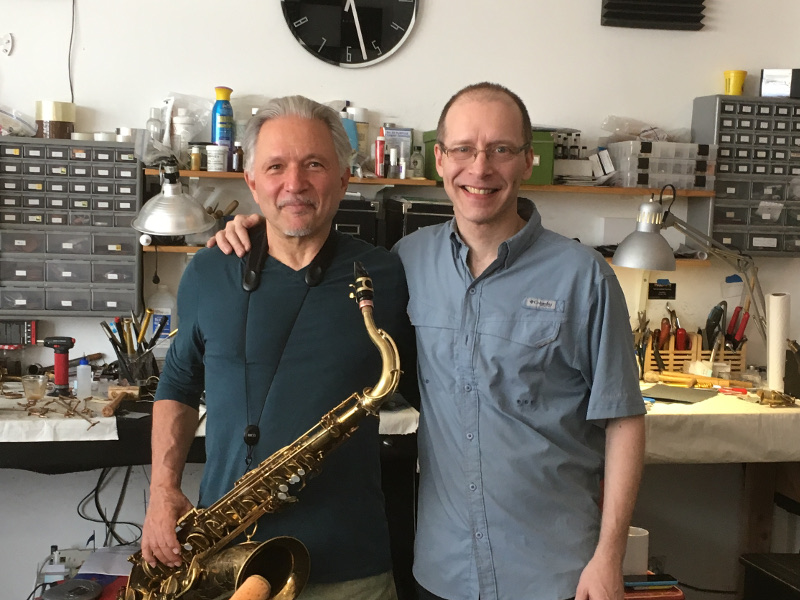
Jerry Bergonzi who is extremely sensitive to the most minute changes in the equipment, working on his own mouthpieces for most of his life, can detect a difference of 0.001-2” in the “tip” opening of a neck. He can also consistently determine the subtle changes in sound and response characteristics of various brass alloys.
Ben Wendel, another player who is highly critical with his choice of equipment and possesses great sensitivity to the slightest change of sound or feel. Ben has helped shape the development of the Vanguard line, in particular with the addition of the C-69 brass model.
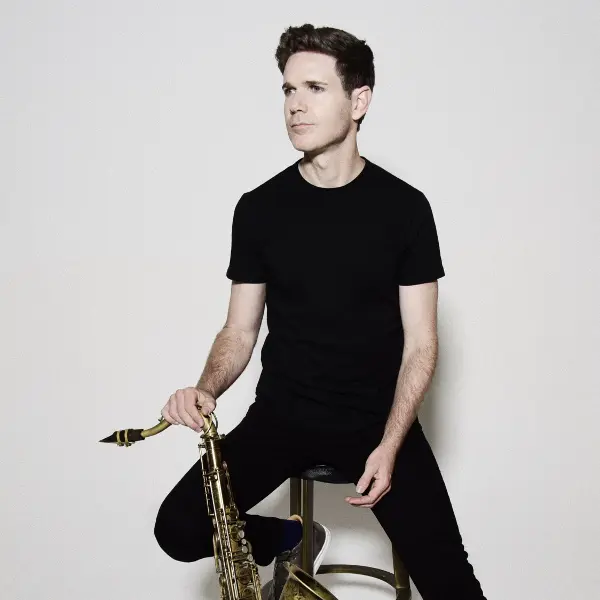
(Photo credit: Shervin Lainez)
We cannot overstate our appreciation for the many players’ help and feedback in shaping what has become the KB Sax necks of today. Their feedback & advice form part of the standard that Kim Bock consistently applies to making each KB saxophone neck.
Throughout the process of making, playtesting and fine tuning each KB Sax neck, Kim Bock channels the feedback he received from all these respected saxophone players into the saxophone necks.
In other words, what you get to experience when you play a KB Sax neck is a collective of experiences from many of these top level players.
Related: Where did you get the idea of making these saxophone necks?
Improvements from our unique design and process
Sound . Response . Intonation . Projection
First of all, it is important to point out that being the first part of the saxophone where the sound waves enters, it naturally means that the saxophone neck has a greater impact on the instrument’s performance than any other part of the saxophone.
This is an important point to grasp because the impact a saxophone neck can make can be significant, whether it is a good neck, a poor neck or one that is somewhere in between.
The impact KB Sax necks have come as improvements in these 4 areas: Sound – Response – Intonation – Projection. We will talk more of each area below.
These improvements are due to a number of factors in the design and build of the KB necks. An important factor is how we make them.

Traditionally, a saxophone neck is made by forming a metal sheet around a mandrel to create a conical tube. The tube is then filled with supporting material and bent over a form to give it the specific shape of a saxophone neck. Because of the mechanical nature, some parts of the metal are thereby stretched much more than others, resulting in a neck which has varying wall thickness.
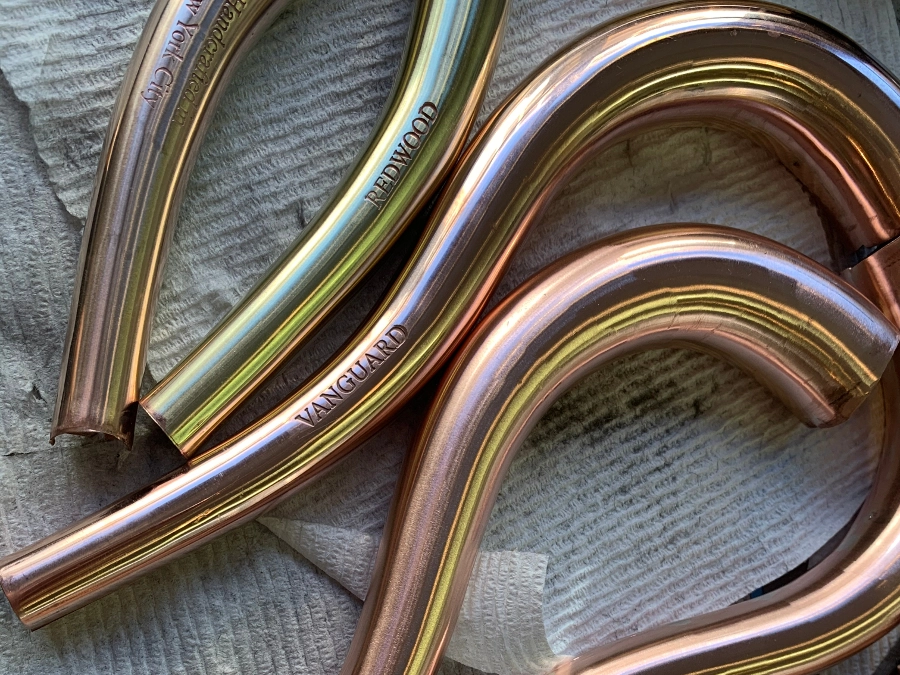
Kim Bock created a fundamentally different build process (we call it the “mirror-twin” process) which ensures each saxophone neck has an even wall thickness throughout – something that is not possible to achieve with the traditional method.
The idea of “mirror-twin” is beautifully simple and yet the actual build process is labor intensive and requires various specialized tools. It is highly intense and precise work to shape the metal correctly and keep all tolerances within a narrow margin.
Kim Bock specifically developed these tools that would allow him to create a saxophone neck that are made of two “mirror-twin” halves, the left and right side of the neck, without stretching the metal. The importance lies in the uniformity of wall thickness throughout the neck. This helps make KB Sax necks sound and feel so resonant and even responding.
Sound and Response
With this consistency in wall thickness, the sound wave is now reflected back evenly throughout the neck – including at all nodal points, and therefore not losing energy or changing amplitude, thereby ensuring an even sound throughout the complete range of the saxophone as well as enhancing the response and stability of the altissimo range – an area that is challenging to many players.
Intonation
A lot of care was dedicated to fine tuning the intonation of the KB Sax necks by optimizing the inner dimensions, resulting in precisely dialed in octaves in the entire range as well as improved pitch stability in the upper range – the second octave from A and up into the palm keys is often a problem area where notes tend to play sharp on other necks.
This improvement in intonation found with the KB sax necks holds true across the board of different saxophone makes. Whether you are using a KB Sax neck on a vintage Conn or Selmer, a Mark VI or on modern saxophones like Yamaha, Keilwerth, Selmer, Yanagisawa as well as the Chinese and Taiwanese makes, the KB Sax necks improve the intonation on all horns!
Projection
Does your sound truly carry through the room so the people listening in the back can hear you clearly, with no amplification? Or do you experience that although you have a beautiful sound when playing alone, once on the band stand, you feel buried in the music, you struggle to hear your sound or even feel the tonal feedback through the mouthpiece? And 50 feet out, people can barely make out what you are playing…Well, the neck has a large impact on the projection of the saxophone and how well we feel the tone while playing.
How well a neck projects, shouldn’t just be a random afterthought, where some necks turn out to have great projection and others do not. It is entirely possible to determine how well a neck projects by balancing the following three things: 1) the metal the neck is made of, 2) the weight of all materials used (including the specific wall thickness of the neck tube) and 3) the specific dimensions of the neck tube.
In developing the KB Sax necks, projection was and still is one of our priorities and we have carefully calibrated all parts to optimize this element of the playing experience.
Since there is a direct relationship between the weight of all parts of the neck and the projection, tonal color & response of the neck, we worked hard on it to get this balance just right so both the projection and sound are optimized.
The careful choice and treatment of the metals used in the making of the KB Sax necks results in a sound with a deep resonance and greater projection. A lot of research and development work has gone into examining and testing heat treatment of different materials as well as developing a consistent hand hammering process of copper and bronze that ensure the correct balance between the resulting metal hardness and the response and tonal color of the neck.
Hand hammering
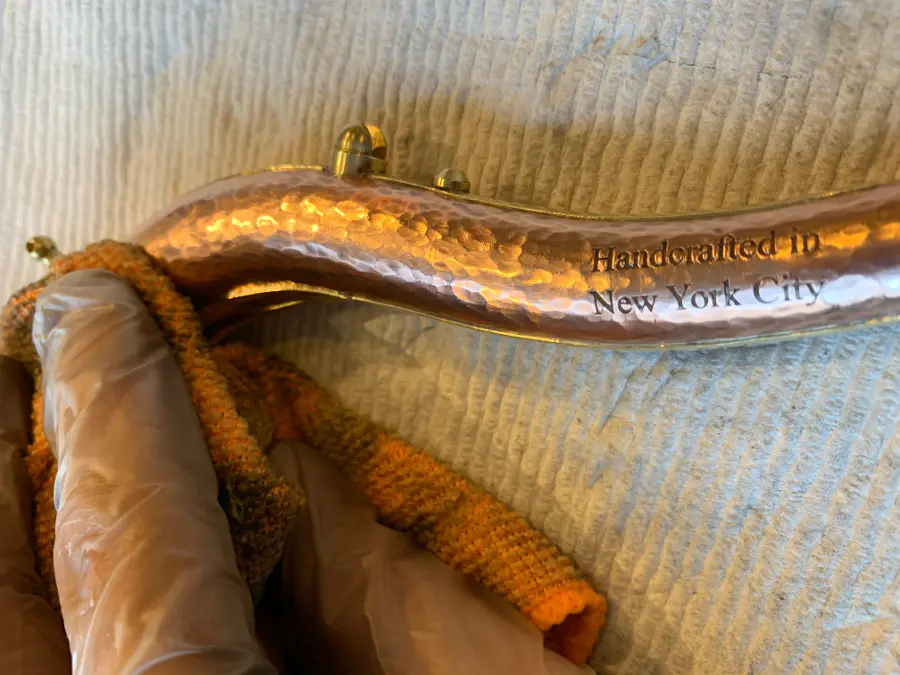
Our signature design of hand hammering the copper and bronze tubes are not merely for the stunning visuals. Inspired by the legendary cymbal makers of the past, where master craftsmen painstakingly hand hammered each cymbal to bring out the exact resonance they were seeking, so it is with the hand hammered KB Sax necks.
We have developed a consistent and deliberate hand hammering process that both hardens the necks so they are not prone to pulldowns, but also brings out the desired sound, resonance and response characteristics of the neck.
Fact # 1
Do you know that many conventional saxophone necks tend to “run sharp” in the upper range? Additionally – a lot of times, a conventional neck will have one sound color (timbre) in the low range, but change in the mid-range, and change again in the palm keys and above.
Handcrafted + Tech
Precision Engineering

It is a known fact that it requires a significant amount of man hours to create each single handcrafted saxophone neck. At KB Sax, we balance handcraftsmanship with modern technology to produce our saxophone necks to a high level of precision and consistency.
All tolerances throughout the process of making these handcrafted necks are strictly adhered to, ensuring each KB neck of a given model and metal always play the same.
Right from the outset of the KB neck venture, Kim Bock decided to set up the neck making process from the ground up, so that not a single part or process will be overlooked, and he can retain 100% quality control over it.
We obsess over every step of the process. Starting with procuring the different metals from shops here in the US and all the way to the very last stage, where Kim Bock carefully does a final inspection of dimensions, build quality and finish.
Finally every KB neck is thoroughly play tested by Kim Bock to ensure it meets his standard before the neck is delivered to the customer.
Read more: How did you start to figure out how to make a saxophone neck?

KB Sax necks vs "other" necks
The KB Sax necks are very different from both the brand name factory mass produced necks and the cheaper Asian imports, where any given shop in the world can select a generic, mass produced neck from one of the factories in Asia and call it their neck.
All these shops then has to do is to decide on the octave key design and simply have their name and logo stamped on the necks before they are shipped from Asia to their shop.
The latest we have seen is that one Asian factory has begun copying our hand hammered copper design. At a glance, their copies may look somewhat similar to our KB Sax necks but a closer look will reveal quality differences. The main difference however remains – those necks are not built the same way as Kim Bock builds his necks and therefore the “copy-necks” will never perform like a genuine KB sax neck.
In addition, some sellers unfortunately use questionable claims about having done extensive research and development, seemingly to justify a high price point – conveniently avoiding any mention of the neck’s true origin. In our opinion, those saxophone necks are somewhat akin to near identical prefab houses just with different paint color schemes to give a sense of individuality.
You may be getting the same generic Asian produced sax neck from one seller for say $300 and from another for $700+. This product branding scheme is of course not limited to saxophone products like necks but applies to countless other things produced in Asia and sold through shops worldwide.
The good news is that you can still find a small handful of saxophone neck makers, who are still truly crafting their products using their special skills and knowledge.
We encourage you to ask questions, find out and decide for yourself.
Fact # 2
Have you noticed the market is increasingly flooded with saxophone necks with nebulous marketing claims of being made/developed in the US, Europe or Japan? Most are in fact cheap generic imports from Asia – they merely have the different shops’ names and logos stamped on them.
True Upgrade
Not simply a replacement or aftermarket neck
(and it's not just us saying so)
The KB Sax necks are much more than just replacement or aftermarket necks. In fact, most players that switch to our saxophone necks have perfectly fine and undamaged original necks for their horns.
Whether it is on a vintage Selmer Mark VI or a modern Yamaha, countless players have found the KB Sax necks to be a significant upgrade from their original saxophone neck.
Then, for giggles, I put the copper neck on my Supreme... And just about fell over. Wow. I am in love. What a lovely sound. Super stoked that the neck fits both horns. I can totally see recording with that setup."
Custom Fit
Exact fit to the finest tolerance of 0.001" with our proprietary gauges
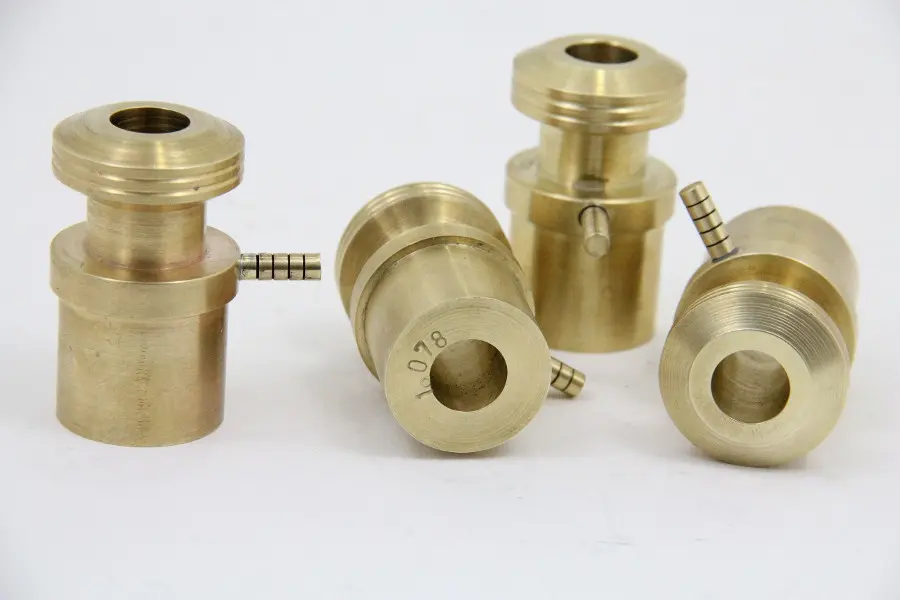

The tenon receiver (the part of the saxophone the neck slides into) changes with use. To ensure accurate fit, each neck is sized and customized to fit your horn by using our proprietary gauging system. Read more about our measuring gauges and details on how to use them.
Our neck can be fitted to “tricky” horns, like for instance the old Conn saxophones, where the tenon receiver depth is less than conventional tenons.
Since we are custom making and fitting every single tenon, we have the fullest control over all dimensions to ensure you get a neck that fits as well as possible.
Fact # 3
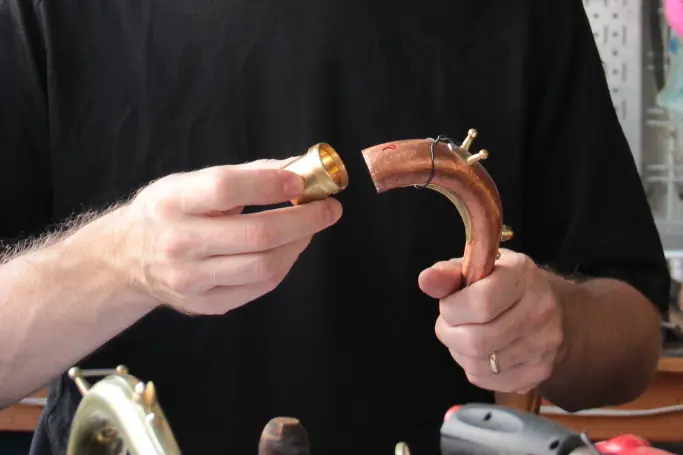
A tenon receiver changes with use. The more used the horn is, the bigger the receiver usually gets. Unless the saxophone is new, each horn is therefore different, regardless of serial number, and if possible, should be custom measured with our measuring gauges for optimal neck fitting.
Changing saxophone? No worry.
We can re-fit your KB Sax neck to a different saxophone
We offer a tenon-changing refitting service for our KB Sax necks.
If you have a KB Sax neck and want to use it on a different saxophone than what it was originally fitted for, we can install a new tenon so it is custom fitted to your new horn. We will send you our tenon receiver measuring gauges and get the precise measurement of the new saxophone. A new tenon will then be installed on your KB Sax neck so it fits your new saxophone.
Having a precisely measured and fitted tenon is very important for the best possible connection in this crucial point between neck and horn. This allows for best resonance and sound transfer from neck and into the saxophone.
Sure, you can get your current tenon expanded or swedged/sanded to fit but it is not recommended when there is a better alternative. When you alter a neck tenon, it is practically impossible to do so evenly and you will have less than optimal contact between the neck and the saxophone.
Please note that if you have a lacquered or plated neck, and you wish to avoid showing any evidence of tenon change, it will need to be re-lacquered or re-plated if you change the tenon.
Neck ordering process
You can visit one of our dealers or you can place an order through our website (ordering online is currently unavailable but this option will return shortly).
To purchase via our website, you will be asked to enter your “saxophone info” in the comment box during check out – last step before you click “Place order”.
Saxophone info we will need are:
(1) the brand of your saxophone, eg. Selmer
(2) the model, eg. Mark VI
(3) the serial number
(4) the condition of your saxophone (like-new, somewhat used, very used)
International Customers
If you have measurements for the neck, please include it in the comment box. More info about measuring.
For US Customers
After we receive your order, we would then send you a set of 4 measuring gauges. When you receive the gauges, with the instructions (also available online), you can fit them onto your saxophone and let us know which size fits best, so we know which size tenon to use on your neck. We ask that you ship the measuring gauges back to us within 7 days of receipt. All shipping is covered by us.
For all orders
After we receive your order, we would then make the neck (unless of course if we have them in stock).
Once you receive the neck, you would have 14 days to try it out. If you wish to return it within that period, you will receive a full refund less 6% of restocking fee. International customers: shipping costs are non-refundable.
Please see details in our store policy.
Please do not hesitate to contact us if you have any questions.
We are here to help with suggestions for which KB Sax neck to pair with your saxophone based on what you are looking for.