7 Parameters
Saxophone Necks Comparisons
Here we will go over the 7 parameters we use to define and compare different saxophone necks. It can be challenging to put into words how we each hear the sound or feel the response of a given setup. By defining these parameters, we will be better able to convey how the various necks sound, feel to play as well as how they compare to other necks.
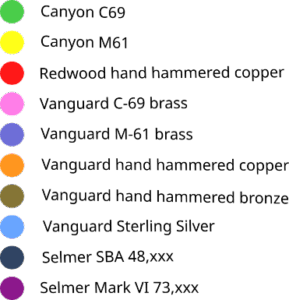
First, here is the key to identify each neck:
(1) SOUND
Pure Complex
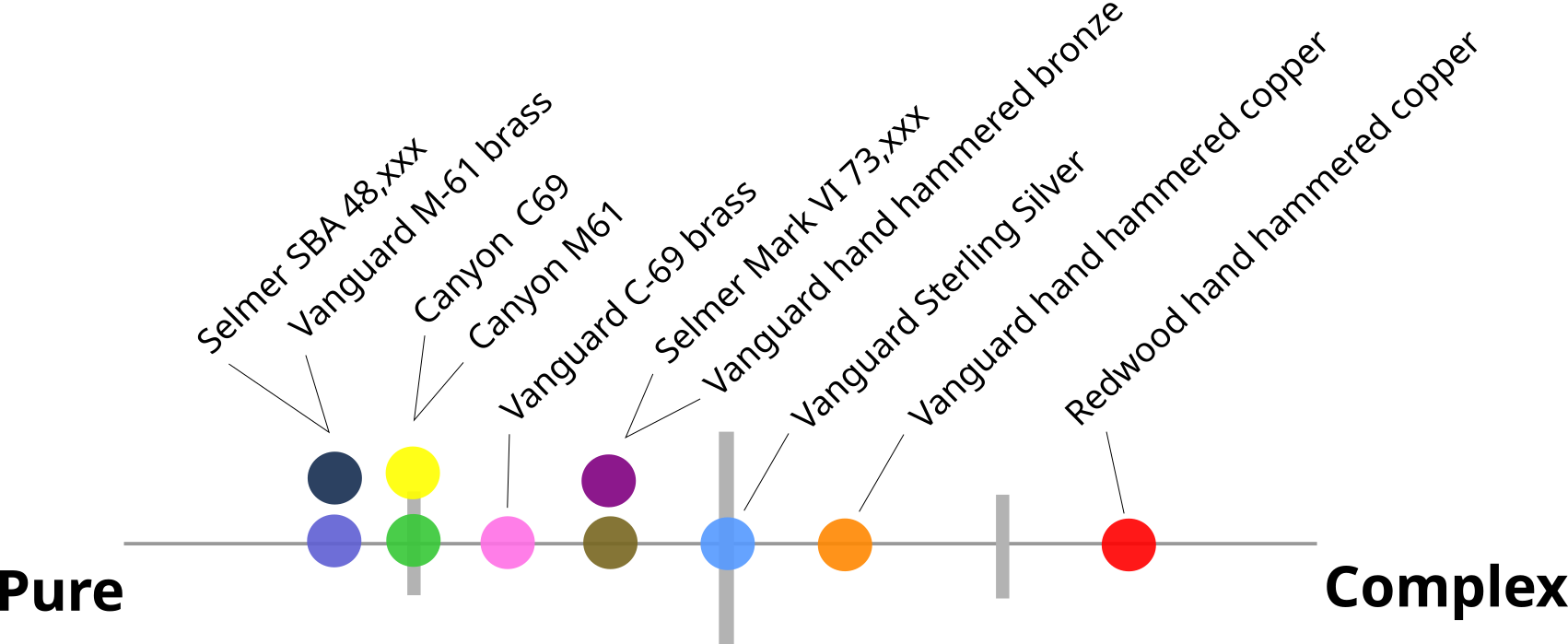
A more pure sound will have an even frequency spread from low to high and will come at you in a uniform way and could be characterized as a straight and beam-like sound.
The more complex sound will have more varried and pronounced mid-tone frequencies, thereby being more colorfull and with a sense of more moving elements or variation in the frequency makeup.
To name a few players that are examples of a sound with more of a pure characteristic, I would suggest Michael Brecker, Chris Potter & David Sanborn. And a few players with more of a complex sound are Joe Henderson, Bergonzi, Lovano, Rich Perry & Kenny Garrett.
(2) TONAL FEEL / FEEDBACK
Slender Wide
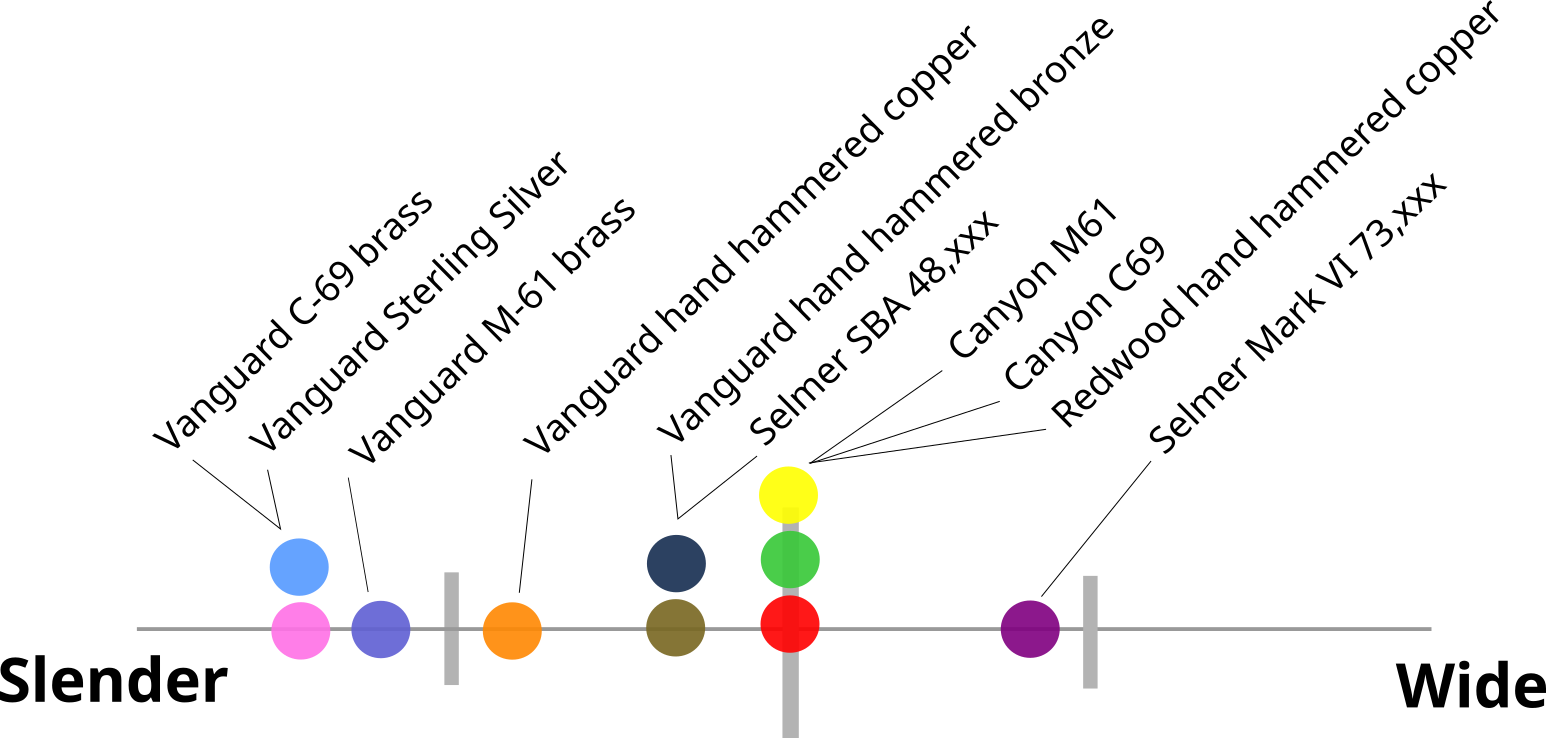
This parameter is the feedback you feel back through the mouthpiece from the neck: Does it feel narrow, tight and focused with more back pressure? Or is it wide, open, free-blowing and with less back pressure?
A narrow tonal feel will be slightly more resistant than a wide and free-blowing tonal feel. A narrow tonal feel increases the sense of projection and wider tonal feel may feel like the sound fills up the space around you more but doesn’t so much “shoot” out of the horn in a straight line.
If a neck feels very wide, open and free blowing, the articulation can suffer since there is little back pressure to lean against. Many players (including Bergonzi, Wendel & Chad LB) prefer a saxophone neck with more back pressure and a tighter focus since it enables an elastic and flexible articulation.
Some resistance in a neck is not a negative, if all air or energy instantly activates sound.
Bad resistance is what you get when you have an out-of-round, pulled down and/or otherwise less than optimally designed and fabricated neck, where you lose energy and the neck is ineffective with your air.
More on resistance / back pressure versus free blowing
I have had many conversations with players about saxophones and necks, where the term free-blowing is held up as an absolutely positive quality. In my experience, a certain amount of good resistance and back pressure is actually a very positive thing! In designing and making a neck, you can actually control the resistance level very accurately without sacrificing immediacy and quickness of response. This is done by having the correct amount of focusing of the air stream at the beginning of the neck tube – balanced out with overall dimensions, materials, wall thickness, etc.
This good kind of resistance actually helps your articulation as there is something to push against – a certain elasticity in the response. On the other hand, no or very little resistance and an open and free-blowing neck will feel like you are playing into an empty void and articulating notes (tongueing) will feel sloppy and harder to control and can give a sense of the articulation running away from you.
(3) & (4) TONAL COLOR
At medium and maximum volume
Dark Bright
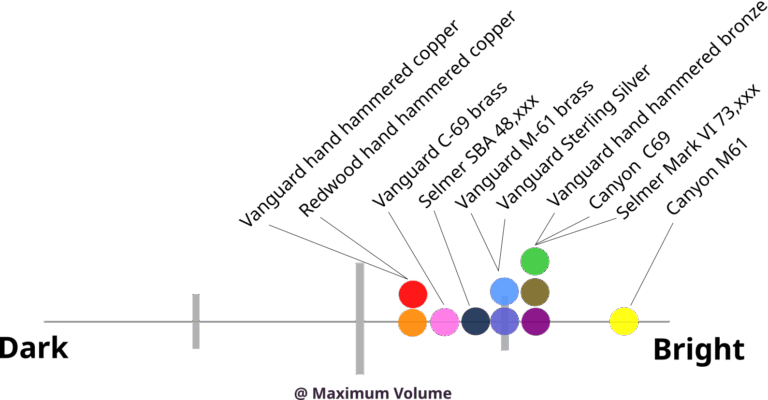
These two parameters refer to how dark or bright a neck sounds and also how this dark/bright balance of the sound changes from playing at a medium volume level to a maximum volume level. Some necks can brighten up more than others when playing at maximum volume.
(5) & (6) PROJECTION
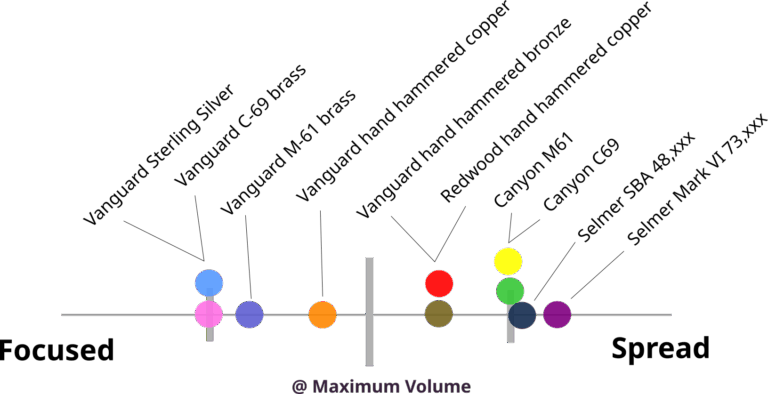
At medium and maximum volume
Focused Spread
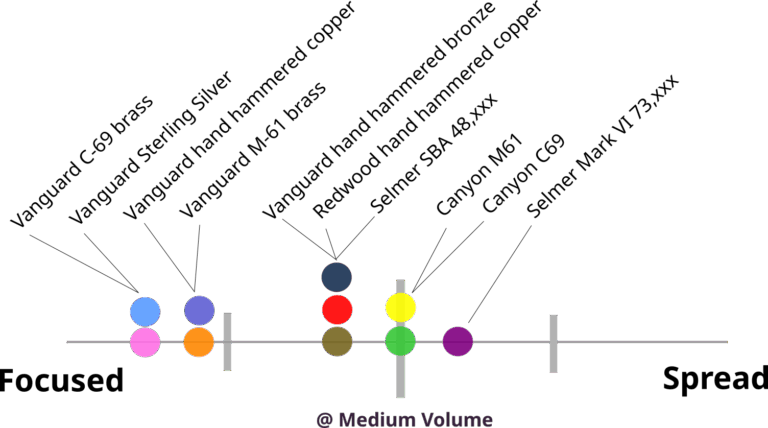
These parameters tell us both how focused or spread a neck plays and also how much it changes and get more spread as the volume increases to maximum. Some necks will hold the core focus at high volume playing while others will spread out more at high volume levels.
(7) DYNAMIC RANGE
Small Large
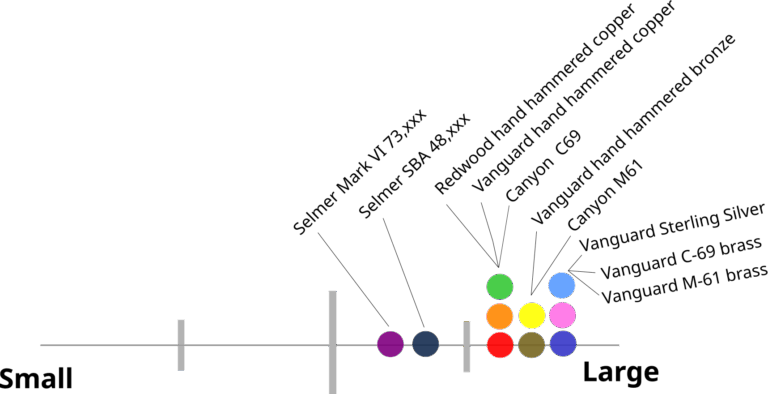
There is quite a difference in how far you can push different necks. There is a point where you will hit a wall and some necks just have a larger dynamic range than others.
We hope that defining and analyzing these different parts of sound and playing experience of a neck will be helpful.