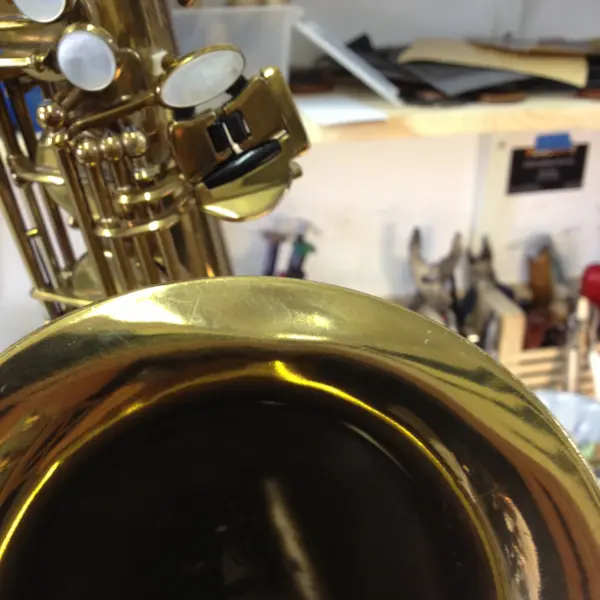
The doorbell rings and there are a couple of deliveries – some tools and supplies and a horn. Ah yes, this is the mint 5-digit Mark VI that was overnighted.
The person called after he shipped it, saying he had decided to have me look at his prized horn since he just couldn’t get anybody to set it up so the low end responded well. I had asked how he had prepared and packed it for shipping – “Oh, I used lots of foam peanuts around the case and I overnighted it so it wouldn’t have to rattle around in a truck across the country!”
Sure enough, as I unpacked it, there was zero protection around the sax inside the sax case. The horn had been shaking and moving around in the Tripack case and now had a bend down bell flare besides the obvious leaks incurred!
That didn’t have to happen. You can do a lot to minimize the risks inherent in shipping a horn.
The first thing to know about shipping a horn is that no matter what carrier (Postal service, UPS, Fedex, DHL, etc), the shipping box WILL be dropped from heights, thrown around, etc. This is the nature of how all carriers handle packages. Not necessarily the truck drivers but more so the automated conveyor belts in the different facilities that the shipping box will transit through.
For packing a horn to enable safe shipping, there are a couple of important things most people are not aware of. First of all, the horn should not be able to move at all within its own sax case! You would want to use foam or even better small bubble wrap (good quality ones – beware of reusing compressed bubble wrap) around the horn wherever there is extra space for the horn to shift around so that it is perfectly fixed when the case is closed (without adding excessive pressure on any parts of the horn of course!)
Secondly, you should use a shipping box that is large enough to allow a 2-3 inch layer of large bubble wrap on all sides of the sax case. We do not like “peanuts” for shipping material since they tend to move around during shipping (plus they are soooo annoying to clean up when you take the horn out! …but fun for the kids.)
Layers of large bubble wrap wound tightly around the sax case is our preferred material. It is important that you use the bubble wrap to completely “fill out” the shipping box so there are no “air pockets” around the sax case. This will cause the sax case to move around inside the shipping box and could mean you don’t have the 2-3 inches of protective bubble wrap around the sax case anymore.
Again, once you are finished packing the horn, ask yourself: Do I feel good about throwing this shipping box against the wall? Dropping it 4 feet? You get the point…
It is not a happy phone call to have to make when we receive a horn that is damaged from shipping. A bell flare can be repaired – although the devaluation will be a fact, and leaks can be fixed, but it is of course so much better to avoid all this in the first place by packing the horn as best as you can.
We also have a video on how to pack a saxophone that we posted on Youtube a few years ago that you may find useful.
More blogs
Does it matter if you have a pulled down saxophone neck?
The part of the neck that changes when a pull down occurs is the area under the octave key saddle – right in the 90 degree curve of a tenor neck. A neck with a pull down will have gone from a round shape to an oval shape in that … Read more
Saxophone tuning – Finding the right tuning spot on a saxophone neck
To find the correct tuning spot when trying out saxophone necks, try comparing the new one to the neck you normally play. On you own neck, with your mouthpiece in the same spot on the neck cork where you always have it, play 3 notes in the second octave – … Read more